Government of Nepal
Ministry of Water Supply
National Water Supply and Sanitation Research, Innovation and Capacity Development Center
Nagarkot, Bhaktapur
Important Notice

A.D.:
Nepal Samvat: 1146 CHAULAGA PARU - 16
A.D.:
Nepal Samvat: 1146 CHAULAGA PARU - 16
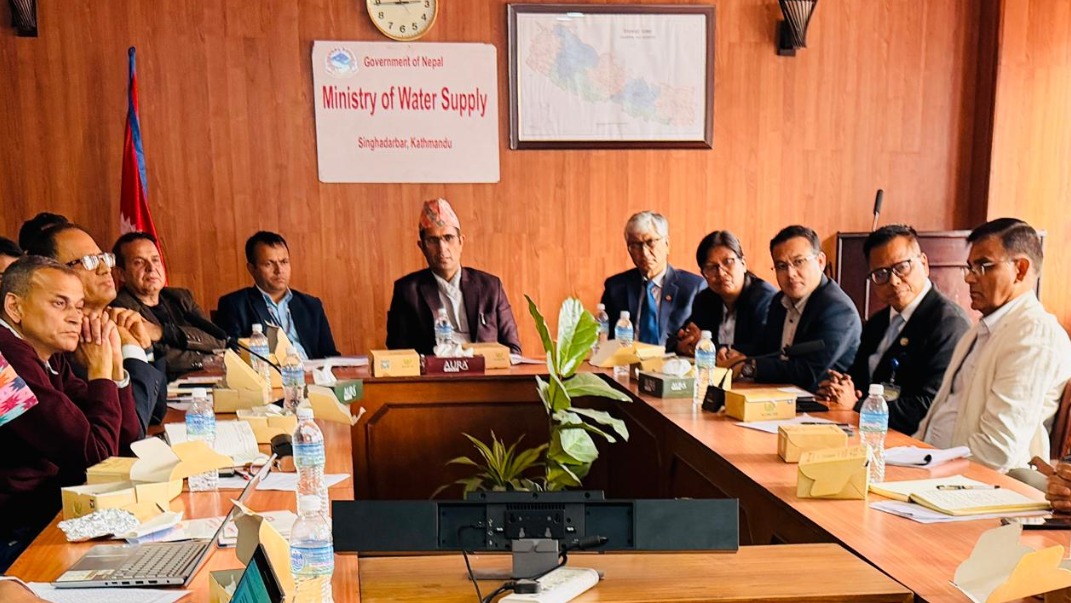
Kathmandu: A research coordination meeting has concluded that integrated, multidisciplinary, and data-driven research needs to be accelerated for the sustainable management of groundwater in Nepal.
The meeting, organized by the National Water Supply and Sanitation Research, Innovation and Capacity Development Centre and chaired by Secretary of the Ministry of Water Supply, Bishwo Babu Pudasaini, emphasized that groundwater management should be viewed as a comprehensive system rather than through fragmented, isolated studies.
It highlighted the need for integrated mapping of multi-aquifer systems instead of limiting studies to a single aquifer, along with the establishment of monitoring wells and the development of continuous monitoring systems. It was also stated that studies related to surface discharge, recharge areas, and water quality should be prioritized, and a data-driven decision-making system should be developed, as informed by Executive Director Er. Ram Kumar Shrestha of the Centre.
The meeting stressed the importance of strengthening inter-institutional collaboration and expanding coordination among the Ministry of Water Supply (MoWS), Ministry of Forests and Environment (MoFE), Ministry of Health and Population (MoHP), and universities. Discussions were also held on further systematizing collaboration through a G2G framework and Memorandums of Understanding (MoUs).
Similarly, the meeting concluded that establishing a data bank, maximizing the use of existing data, and developing regular monitoring systems are essential for advancing research in the long term. It also emphasized the need to regulate increasing groundwater extraction in the Terai through a licensing system and to conduct special studies in high-risk (hotspot) areas.
The meeting also strongly raised the need to prioritize studies on the impacts of climate change, future water availability and use, the application of isotope techniques, and transboundary collaboration with India. Additionally, it pointed out the need for policy provisions related to water reuse and recycling, noting the current lack of such policies.
Participants in the meeting included the Secretary, Joint Secretaries, and Under Secretaries of the Ministry of Water Supply; officials and staff of the National Water Supply and Sanitation Research, Innovation and Capacity Development Centre; and professors from Tribhuvan University, Kathmandu University, the Institute of Engineering, NAST, Tri-Chandra College, and other institutions.
Academic institutions play a key role in providing technical expertise, conducting field studies, preparing research reports, and carrying out laboratory testing during research.
A stakeholder meeting organized by the Centre in late 2025 had already highlighted the need to integrate resources for evidence-based studies in the WASH sector.
Groundwater is an extremely important resource in Nepal as it forms the basis of drinking water supply across the country and is currently under threat. Many communities in hilly and mountainous regions depend on springs, which play a vital role in drinking water, irrigation, and ecosystems.
Recent studies have shown that excessive extraction in the Kathmandu Valley has led to serious depletion of aquifers, traditional springs are drying up, many springs in hilly regions have already dried or disappeared, and more than 30% of taps and wells in the Terai/Madhesh region have dried up due to the 2025 drought.